
Blackjack Basic Strategy: The Chart Every Player Should Memorize
Sit down at any blackjack table and watch long enough, and you will see it: a player stands on a hard 16 against a dealer's 10, or splits a pair of tens because they look tempting, or waves off a double down because it feels risky. These are the moments where the house edge quietly grows. Blackjack rewards patience and discipline more than almost any other casino game, and the players who consistently give themselves the best chance are the ones who play by the numbers instead of by gut feeling.
That is where blackjack basic strategy comes in. It is not a betting system, a superstition, or a hot streak trick. It is a precise, tested set of decisions for every hand you could possibly be dealt, matched against every card the dealer could be showing. Learning it does not require a math degree, just repetition and a willingness to trust the chart over your instincts.
In this guide, we will break down exactly how basic strategy works, how to read the chart, and how to practice until the right decision becomes automatic. If you are still getting comfortable with the fundamentals, it helps to start with how to play blackjack from the basics before diving into strategy, since the chart assumes you already know the flow of a hand.
Why Basic Strategy Works
Basic strategy is a mathematically derived set of decisions covering every possible hand combination a player can hold against every dealer upcard. Instead of relying on intuition, it tells you precisely when to hit, stand, double down, or split, based on the statistically best outcome for that specific pairing of your hand and the dealer's visible card. Nothing about it is guesswork. Every recommendation on the chart exists because it produces the best long-term result across thousands of simulated outcomes.
The reason this matters is simple: basic strategy lowers the house edge far more effectively than playing by hunches. A player who guesses their way through a session, standing when they feel nervous or hitting when they feel lucky, gives the casino a much bigger structural advantage than one who follows the chart. Over time, those small, repeated mistakes compound into real losses. Basic strategy closes that gap as much as mathematically possible without counting cards or altering bet sizes.
It was not invented overnight or by a single lucky guess. Basic strategy charts were built by analyzing millions of simulated hand outcomes, tracking exactly how often each possible decision (hit, stand, double, or split) led to a win, loss, or push across every combination of player hand and dealer upcard. The result is a decision framework that has been stress-tested far beyond what any individual player could replicate through trial and error at the table.
Basic strategy turns guesswork into a repeatable, statistically grounded decision at every hand.
The Math Behind the Chart
Every cell on a basic strategy chart represents the single play that produces the best long-term expected outcome for that exact hand and upcard combination. That does not mean the recommended play always wins. It means that, if you played that same situation thousands of times, the recommended decision would come out ahead more often (or lose less often) than any of the alternatives. This is a critical distinction: basic strategy is about maximizing expected value, not guaranteeing a result on any single hand.
It is also worth knowing that basic strategy assumes standard rules, things like the number of decks in play, whether the dealer stands or hits on soft 17, and whether doubling after splitting is allowed. Because these rule variations can shift the correct play in a handful of edge cases, it pairs best with knowing your table's specific rule variations. Reading the full blackjack rules explained alongside your strategy chart will help you spot any small adjustments needed for the exact table you are playing at.

Reading a Basic Strategy Chart
At first glance, a basic strategy chart can look intimidating, a dense grid packed with letters and colors. But once you understand the layout, it becomes one of the fastest reference tools in casino gaming. Charts are laid out as a grid with the player's hand listed along one axis, usually down the left side, and the dealer's upcard listed along the other axis, typically across the top. Every possible combination of those two variables has its own cell somewhere in that grid.
Most charts use color coding or letters, sometimes both, to mark the recommended action for each cell: hit, stand, double, or split. This visual shorthand is what makes the chart usable in real time. Nobody has time to read a paragraph of explanation mid-hand, so the entire decision-making process gets compressed into a single letter or color you can recognize in half a second.
Learning to scan the chart quickly is really the whole game when it comes to using basic strategy at a live table. It is not enough to understand the logic behind it in the abstract. You need to be able to glance at your hand, glance at the dealer's upcard, find the corresponding cell, and act, all within the normal pace of play. That skill comes from repetition, which we will cover in more detail later in this guide.
Player Hand vs Dealer Upcard
The core mechanic of reading any basic strategy chart is matching two pieces of information: your hand and the dealer's upcard. First, find your row based on your two cards, whether that is a hard total, a soft total, or a pair. Then match that row to the column representing the dealer's visible card, which will typically range from 2 through Ace across the top of the chart.
The intersection cell, where your row and the dealer's column meet, tells you the recommended action. This is the single most important habit to build as a new strategy player: always cross-reference both your hand and the dealer's card before deciding. A common mistake is looking only at your own total and ignoring the upcard, which defeats the entire purpose of the chart.
Chart Symbols and Abbreviations
Basic strategy charts rely on a small set of shorthand symbols to keep things compact and scannable. The common shorthand includes:
- H — Hit, take another card
- S — Stand, keep your current total
- D — Double down, double your bet and take exactly one more card
- P — Split, separate a pair into two individual hands
- Ds — Double if allowed, otherwise stand
- Rs — Surrender if allowed, otherwise stand
Some charts add Ds or Rs for conditional double or surrender plays, which exist because not every table offers doubling after a split, or a surrender option at all. When your table does not allow the conditional action listed, the fallback (usually stand) becomes the correct play instead. This is one more reason it helps to understand your table's exact rule set before you start relying on the chart at speed.
Hard Hands, Soft Hands, and Pairs
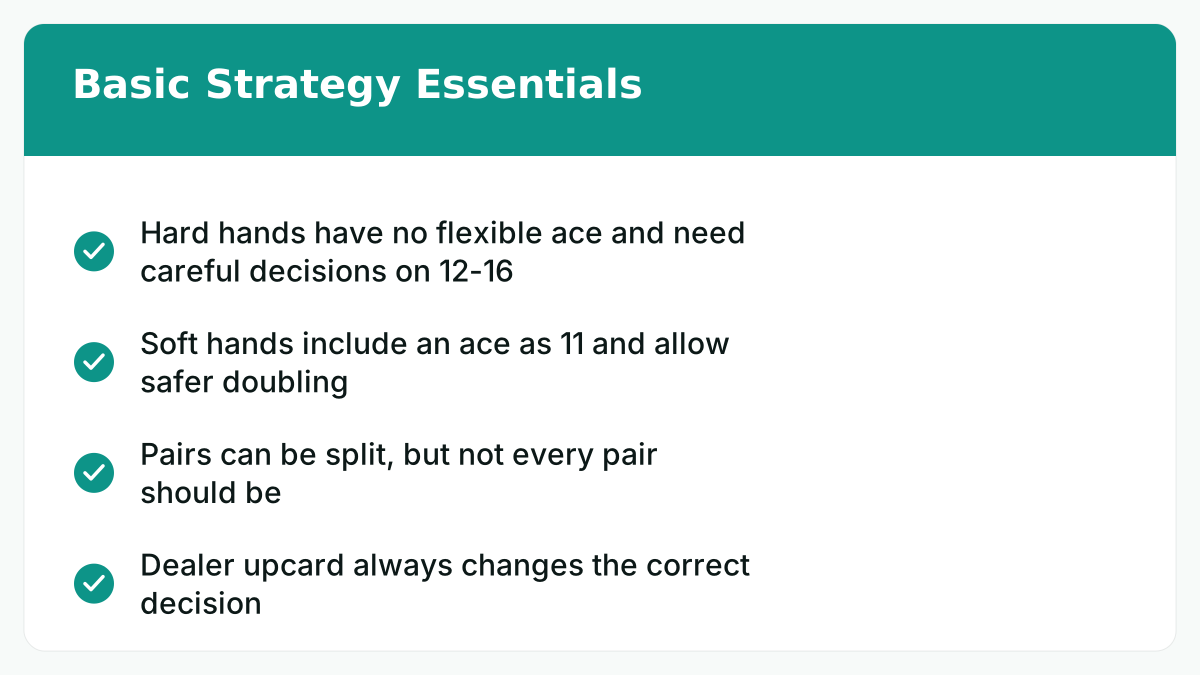
Basic strategy splits every possible hand into three categories, each with its own internal logic: hard hands, soft hands, and pairs. Understanding which category your hand falls into first, before you even look at the chart, makes lookups faster and far more intuitive. Instead of scanning the entire chart for your exact combination, you jump straight to the relevant section.
This categorization exists because the presence of an ace, and whether that ace is counted as 1 or 11, fundamentally changes the risk profile of a hand. A soft 16 behaves very differently from a hard 16, even though the total value is identical. Pairs introduce an entirely separate decision, whether to split into two hands, which neither hard nor soft totals offer. Learning to instantly recognize these three categories is often the single biggest time-saver for new strategy players.
Hard Hands
A hard hand has no ace, or has an ace that can only be counted as 1 without busting. Hard hands are the most straightforward to understand conceptually, but they contain some of the trickiest real decisions in the entire game. Totals like 12 through 16 are notoriously difficult because they sit in a gray zone: too high to comfortably hit without risking a bust, but too low to feel safe standing against a strong dealer card.
These marginal hard totals depend heavily on the dealer's upcard. Against a weak dealer card, standing on a 12 through 16 is often correct because the dealer has a high chance of busting anyway. Against a strong dealer card, the chart will often call for hitting even on a 15 or 16, because the risk of busting is outweighed by the near-certainty of losing to a strong dealer hand if you stand. Reviewing the blackjack rules for how dealer hands resolve can help make sense of why this logic holds up mathematically.
Soft Hands
A soft hand includes an ace counted as 11, which gives the hand flexibility that hard hands simply do not have. Because the ace can drop down to a value of 1 if needed, a soft hand cannot bust on the very next card the way a hard hand can. A soft 17, for example, can take a hit and still land anywhere from 18 down to a hard 7, with zero risk of busting on that single card.
This built-in safety net is exactly why soft hands allow more aggressive doubling under basic strategy. Since a bad hit cannot bust the hand, doubling down on a soft total against certain dealer upcards becomes a mathematically strong play, even when the same total as a hard hand would call for a much more cautious approach.
Pairs
Pairs are the third category, and they open a decision the other two do not have: the option to split into two separate hands, each played independently with its own additional bet. This turns one hand into two opportunities, which can be a major advantage when the pair in question is strong, or a costly mistake when it is weak.
Some pairs, like eights and aces, are almost always split under basic strategy, regardless of what the dealer is showing. Others depend entirely on the dealer's card. A quick reference for common pair decisions includes:
- Aces and eights: almost always split, no matter the dealer's upcard
- Tens (including any 10-value cards): almost never split, since a total of 20 is already strong
- Fives: almost never split, since treating them as a hard 10 for doubling is usually stronger
- Nines: split against most dealer upcards, but stand against a dealer 7, 10, or Ace
- Fours: rarely split, unless doubling after split is allowed and the dealer shows a weak card
When to Hit, Stand, Double, or Split
Once you understand the three hand categories, the next step is understanding why the chart tells you to act the way it does at each decision point. Each decision follows a repeatable pattern once you understand dealer bust rates, which are essentially the probability that the dealer's hand will go over 21 based solely on their visible upcard. This single concept explains the vast majority of what looks, at first, like an arbitrary set of rules on the chart.
Dealer upcards of 4, 5, and 6 are considered weaker for the dealer, meaning the dealer is statistically more likely to bust when required to hit a hand starting with one of these cards. This changes how you should play significantly. Against these weaker upcards, the chart often recommends standing on totals that would otherwise call for a hit, and doubling down more aggressively, because the odds favor letting the dealer take the risk rather than risking your own bust first.
Doubling and splitting at the right moments is where basic strategy gains the most measurable value over the long run. These are the moments where you increase your bet in situations mathematically favorable to you, which is very different from doubling on a whim because a hand feels promising. For a deeper breakdown of these decision points hand by hand, our strategy section walks through specific scenarios in more detail.
The dealer's upcard changes the correct play more than the player's own total often does.
Reading Dealer Bust Probability
Understanding dealer bust probability is the closest thing to a master key for basic strategy. Low dealer upcards, generally 2 through 6, mean a higher chance the dealer will eventually bust when forced to hit their hand up to at least 17. Because of this, playing more conservatively as the player, standing on marginal totals rather than risking a bust yourself, can pay off since you are effectively letting the dealer take on more risk.
High dealer upcards, generally 7 through Ace, flip that logic. These cards give the dealer a strong likelihood of forming a solid hand without busting, which means the player's marginal hard totals need to be pushed further. High dealer upcards call for more aggressive hitting on marginal hard totals like 12 through 16, since standing against a strong dealer card with a weak total is close to conceding the hand outright. A short summary of the general pattern looks like this:
- Dealer shows 2 or 3: lean toward standing on hard 13 or higher, moderate bust risk for the dealer
- Dealer shows 4, 5, or 6: strongest standing zone, dealer bust risk is at its highest
- Dealer shows 7 or 8: lean toward hitting more hard totals, dealer risk of busting drops noticeably
- Dealer shows 9, 10, or Ace: hit aggressively on hard totals below 17, dealer is likely to form a strong hand
Common Strategy Mistakes
Even players who know basic strategy exists often deviate from it in small ways during actual play, usually without realizing it. These deviations feel harmless in the moment but chip away at the mathematical edge the chart is designed to protect. Some of the most frequent mistakes include:
- Standing too early on hard 16 or 15 against strong dealer upcards, out of fear of busting
- Not doubling down on strong soft hands, or on nine and ten totals, when the chart calls for it
- Splitting pairs that basic strategy says to keep together, like tens, because a higher total feels safer
- Playing by feel instead of checking the chart consistently, especially during long or stressful sessions
- Ignoring the dealer's upcard entirely and basing decisions only on the player's own total
- Ing surrender or double options when the table offers them and the chart recommends using them
Each of these mistakes tends to come from an emotional reaction rather than a calculated one. Standing on a hard 16 feels safer than hitting, even when the dealer's upcard makes hitting the statistically correct play. Splitting a pair of tens feels exciting, even though a hard 20 is already one of the strongest hands in the game. This is exactly the gap basic strategy is designed to close, replacing emotional reactions with consistent, repeatable decisions.
Why Deviating from the Chart Costs Money
Every deviation from the optimal play increases the house edge over time, even if it does not feel that way in the moment. A single hand where you stand instead of hit, or split instead of stand, might not seem to matter much. But blackjack is a game of accumulated small edges, and the house edge is calculated across thousands upon thousands of hands, not a single session.
Small mistakes add up across many hands played over a session, and across many sessions played over time. A player who deviates from the chart on even a handful of decisions per shoe is effectively handing back a portion of the small edge that disciplined basic strategy play protects. This is also why table behavior matters: rushing decisions under pressure from other players is a common trigger for chart deviations, and brushing up on table etiquette tips can help you feel less rushed and more able to take the extra second needed to make the correct call.
Every deviation from the chart, even a small one, adds to the house edge over time.
How to Practice Until It Becomes Automatic
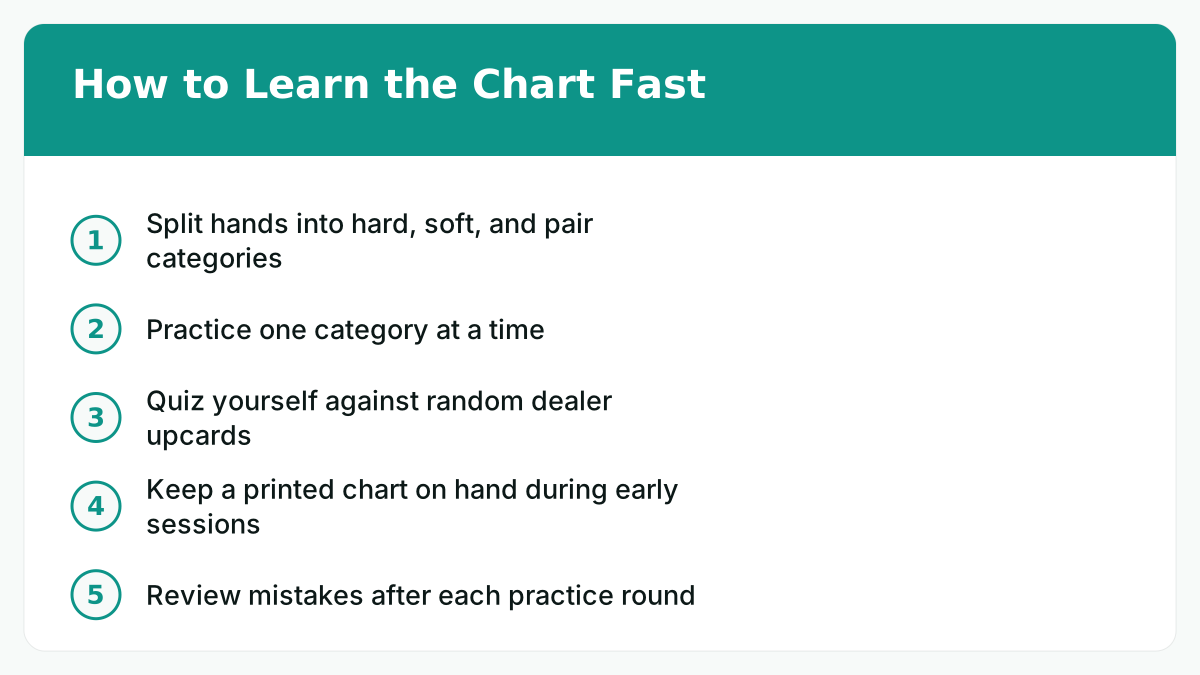
Knowing that basic strategy exists is one thing. Being able to execute it instantly, in the middle of a live hand with chips on the table and other players waiting, is another skill entirely. Repetition with a chart in hand builds muscle memory faster than memorizing rules abstractly. Rather than trying to memorize the chart cell by cell in one sitting, most players find it far more effective to build recognition patterns through repeated practice.
Practicing hand by hand at low stakes lets you check decisions before they become costly habits. This is a critical middle step between reading the chart and playing confidently without it. Rather than jumping straight into full-speed play, take the time to slow down, deal yourself practice hands, and consciously reference the chart until the correct play starts to feel obvious before you even check.
Simple Drills to Build Recall
A handful of simple, low-pressure drills can dramatically speed up how quickly basic strategy becomes second nature. Consider working through these methods:
- Quiz yourself on random hand and upcard combinations away from the table, using flashcards or a notes app
- Practice one hand category at a time, starting with hard hands, then soft hands, then pairs
- Keep a small printed chart nearby during early practice sessions until recall feels automatic
- Play low-stakes or free practice rounds specifically to test your recall speed under light pressure
- Review your own mistakes after a session by writing down any hand where you hesitated or guessed
- Re-test yourself on categories you previously struggled with until the hesitation disappears
Keeping a small printed chart nearby during early practice sessions is not a sign of weakness, it is a standard part of the learning curve for every player who eventually plays basic strategy fluently. Over time, as recall becomes faster, the chart becomes less of a crutch and more of a confirmation tool, something you glance at occasionally rather than something you depend on for every single decision.
What is blackjack basic strategy?
It is a chart of mathematically proven decisions, hit, stand, double, or split, for every possible player hand against every dealer upcard, designed to lower the house edge.
Does basic strategy guarantee winning?
No, it does not guarantee wins on any given hand, but it gives you the statistically best decision in every situation over the long run.
What is the difference between a hard hand and a soft hand?
A hard hand has no ace or an ace counted as 1, while a soft hand includes an ace counted as 11, which gives it more flexibility when hitting or doubling.
Which pairs should always be split?
Aces and eights are the pairs most consistently split under basic strategy, since holding them as one hand statistically performs worse.
How long does it take to memorize a basic strategy chart?
It varies by player, but practicing one hand category at a time, such as hard hands first, then soft hands and pairs, tends to speed up recall.
Basic strategy is not a shortcut, and it is not magic. It is a disciplined, repeatable framework built on the actual math of the game, and it rewards players who are willing to trust the chart over their instincts. Whether you are just starting to learn the categories of hard hands, soft hands, and pairs, or you are polishing your recall speed on marginal totals, the path forward is the same: study the chart, practice deliberately, and apply it consistently every time you sit down to play.
At Best Blackjack in Abu Dhabi, we built this resource because we believe informed players enjoy the game more and play it with far greater confidence. If you are ready to put basic strategy into practice, explore more guides and strategy breakdowns from Best Blackjack in Abu Dhabi and keep sharpening your decisions one hand at a time.
Ready to sharpen your game further? Visit Best Blackjack in Abu Dhabi for more strategy guides, rule breakdowns, and tips to play smarter at every table.
Explore More Blackjack Strategy